
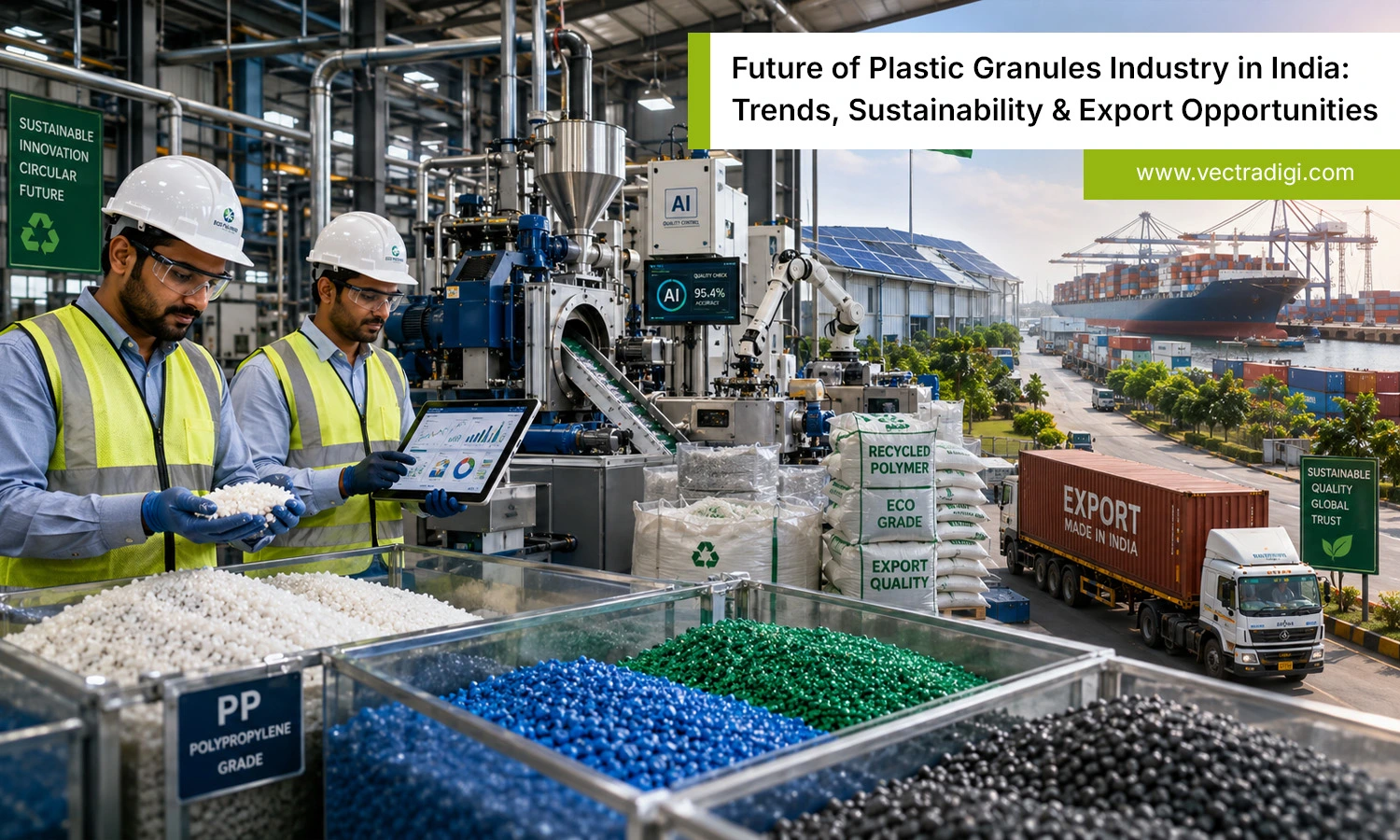
India’s plastic granules industry stands at a defining crossroads — one shaped by evolving global regulations, rising environmental consciousness, and a surging demand for high-performance materials. From automotive components to food-grade packaging, plastic granules form the invisible backbone of modern manufacturing. As industrial ecosystems shift toward circular economies, sustainable plastic granules are no longer a niche concept but a mainstream necessity. With India emerging as both a manufacturing powerhouse and an export hub, the sector is poised for transformative growth. This blog explores where the industry is headed, what forces are shaping it, and how businesses can capitalize on emerging opportunities.
Table of Content
-
- The Current Landscape of India’s Plastic Granules Industry
- Key Trends Reshaping the Industry
- Sustainability at the Core: Regulatory and Market Drivers
- Export Opportunities: India’s Growing Global Footprint
- Challenges the Industry Must Navigate
- The Road Ahead: Strategic Imperatives
- Conclusion
- Frequently Asked Questions (FAQs)
Also Read: From Pellets to Products: Plastic Granules in Modern Manufacturing Industry
The Current Landscape of India’s Plastic Granules Industry
India is among the top five plastic producers in Asia, generating millions of metric tonnes of polymer materials annually. The plastic granules market — encompassing virgin, recycled, and blended variants — serves industries ranging from agriculture and construction to electronics and healthcare. Key polymer types dominating the market include Polypropylene (PP), Polyethylene (PE), Polyvinyl Chloride (PVC), Acrylonitrile Butadiene Styrene (ABS), and Nylon. The industry is home to thousands of small and mid-scale manufacturers, particularly concentrated in states like Gujarat, Maharashtra, Rajasthan, and Tamil Nadu, which collectively account for a significant share of national output. Government initiatives like Make in India and PLI (Production Linked Incentive) schemes have further strengthened domestic manufacturing capacities, attracting FDI and boosting infrastructure investment in polymer processing units.
Key Trends Reshaping the Industry
1. Rise of Recycled and Sustainable Plastic Granules
The most significant shift in the industry today is the accelerating pivot toward sustainable plastic granules. Brands across sectors are committing to using recycled content in their products — driven partly by consumer demand, partly by global ESG mandates, and significantly by India’s own regulatory push. The introduction of Extended Producer Responsibility (EPR) guidelines under the Plastic Waste Management Rules has created a structured obligation for producers, importers, and brand owners to collect and recycle a percentage of their plastic footprint. This directly fuels demand for high-quality recycled granules — a segment that is growing at an estimated 12–15% CAGR. Manufacturers investing in advanced mechanical and chemical recycling processes are gaining a distinct competitive advantage. The ability to produce food-safe, odour-free, and consistent-quality recycled granules is becoming a key differentiator in both domestic and international markets.
2. Bioplastics and Bio-Based Granules
Though still nascent in India, the bioplastics segment is gaining traction. Granules derived from corn starch, sugarcane, or cassava are being piloted in packaging and single-use items. With India’s agrarian base providing abundant raw materials, there is a compelling case for scaling bio-based polymer production domestically. Several Indian startups and academic institutions are already working on plant-based polymer formulations, and this segment is expected to evolve significantly over the next decade as production costs decline.
3. Specialty and High-Performance Polymers
India is witnessing growing demand for engineering-grade and specialty plastic granules in sectors such as electric vehicles (EVs), aerospace, and medical devices. As EV adoption accelerates, lightweight polymer components made from specialty granules — offering heat resistance, flame retardancy, and structural rigidity — are seeing unprecedented demand from OEMs and Tier-1 suppliers.
4. Digitalization of Manufacturing Processes
Smart manufacturing is reshaping how granules are produced and quality-checked. Adoption of AI-powered colour sorting machines, inline viscosity testers, and IoT-integrated extrusion lines is improving output consistency, reducing wastage, and enabling real-time traceability — all critical for meeting the stringent specifications demanded by international buyers.
Sustainability at the Core: Regulatory and Market Drivers
Sustainability is no longer optional for the plastic granules industry — it is structurally embedded in the future of the sector. Here’s why:
Regulatory Mandates: India has banned several categories of single-use plastics, pushing manufacturers to develop alternative-grade granules that are thicker, multi-use, or compostable. The EPR framework mandates targets that will grow year-on-year.
Global Compliance Requirements: Indian exporters dealing with EU, UK, and North American buyers must now align with regulations like the EU Packaging and Packaging Waste Regulation (PPWR), which requires minimum recycled content in packaging materials. Producing certified sustainable plastic granules with documented chain-of-custody is increasingly a prerequisite for global trade.
Corporate Sustainability Goals: Major FMCG, retail, and automotive brands — both Indian and multinational — have made public commitments to use 25–100% recycled or sustainably sourced plastic by 2030. This creates a massive, guaranteed demand pipeline for Indian granule manufacturers who can meet quality benchmarks.
Green Financing: Banks and development finance institutions are offering preferential lending rates for manufacturers who adopt cleaner production technologies, creating a financial incentive to invest in sustainable upgrades.
Export Opportunities: India’s Growing Global Footprint
India’s plastic granules export market has been steadily expanding, with key destinations including the USA, UAE, Germany, the Netherlands, Bangladesh, and Southeast Asian nations. Here’s why the export opportunity is particularly strong right now:
Competitive Cost Advantage
India’s relatively lower labour and energy costs allow manufacturers to offer globally competitive pricing — especially for standard-grade and recycled granules where cost is a primary purchase driver.
Rising Demand in Developing Markets
Economies across Africa, Southeast Asia, and South Asia are ramping up their plastics-dependent manufacturing sectors but lack domestic granule production capacities. India is ideally positioned to be their primary supplier.
Certification and Quality Positioning
Indian manufacturers obtaining international certifications — such as ISO 9001, RoHS compliance, FDA approval for food-grade granules, or Global Recycled Standard (GRS) for recycled grades — significantly expand their buyer universe and command premium pricing.
Trade Agreements
India’s active trade negotiations with the EU and GCC, along with existing FTAs with ASEAN countries, are progressively reducing tariff barriers for polymer exports, making Indian granules more price-competitive in these geographies.
Challenges the Industry Must Navigate
Despite the strong growth trajectory, several challenges need strategic attention:
- Feedstock Volatility: Crude oil price fluctuations directly impact virgin polymer costs, compressing margins for granule manufacturers dependent on petrochemical inputs.
- Waste Collection Infrastructure: The quality of recycled granules depends on the quality of waste feedstock. India’s informal recycling chain, while vast, lacks consistency in sorting and contamination control.
- Skilled Workforce Gap: Advanced polymer processing — especially for engineering-grade and specialty granules — requires trained technical personnel, a resource that remains scarce in semi-urban manufacturing clusters.
- Competition from China: Chinese manufacturers remain aggressive in price-driven segments, making differentiation through quality, certification, and sustainability credentials essential for Indian exporters.
The Road Ahead: Strategic Imperatives
For stakeholders across the value chain — from raw material processors and granule manufacturers to traders and brand owners — the future belongs to those who invest early in sustainability, innovation, and global compliance. Key priorities include:
- Scaling up capacity for sustainable plastic granules through investment in modern recycling infrastructure
- Building international certifications and traceability systems
- Exploring R&D partnerships for bioplastics and specialty polymer development
- Leveraging government schemes and green financing for technology upgrades
- Developing direct export relationships rather than relying solely on intermediaries
Conclusion
The plastic granules industry in India is entering one of its most dynamic and opportunity-rich phases. As global trade shifts toward sustainability-compliant supply chains, India has both the manufacturing capability and the resource base to emerge as a leading global supplier of sustainable plastic granules. Companies that align themselves with circular economy principles, pursue international certifications, and invest in high-quality recycling technologies will not just survive this transition — they will define it. The future of India’s plastic granules industry is green, export-ready, and full of untapped potential for forward-thinking businesses.
Ready to enhance your manufacturing efficiency with high-quality plastic granules? Get in touch today for the latest prices and reliable supply solutions.
Frequently Asked Questions (FAQs)
Q1: Are sustainable plastic granules more expensive than virgin plastic granules?
Ans: Initially yes, but long-term savings and compliance advantages offset the higher upfront cost.
Q2: Which industries in India use the highest volume of plastic granules today?
Ans: Packaging, agriculture, automotive, and construction sectors are the largest consumers of plastic granules.
Q3: How can Indian manufacturers get certified for exporting sustainable plastic granules globally?
Ans: Obtaining GRS, ISO, or FDA certifications through accredited bodies enables access to premium international markets.
.